The Mirror Never Lies: Why Your Trade Outcomes Are Your Best Teacher
In the fast-paced world of trading, it’s easy to focus entirely on the next trade. But at AITradeIdeas.com, we know that the real growth doesn’t happen while the candles are moving—it happens when you look back at where they’ve been.
Published · Updated
In the fast-paced world of trading, it’s easy to focus entirely on the next trade. But at AITradeIdeas.com, we know that the real growth doesn’t happen while the candles are moving—it happens when you look back at where they’ve been.
Recording your outcomes isn’t just about bookkeeping; it’s about building a feedback loop that separates the pros from the amateurs.
The Anatomy of an Outcome
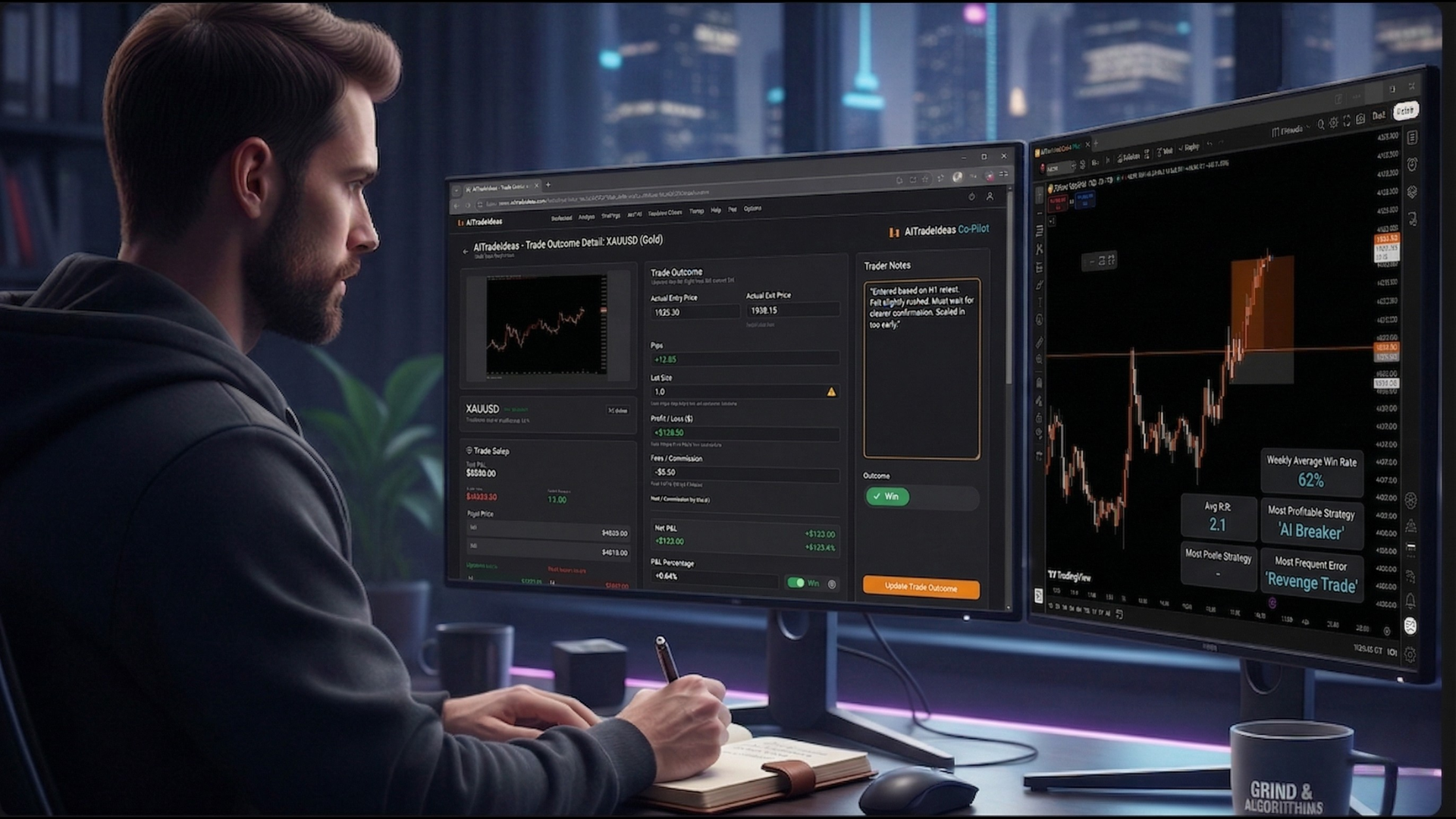
To truly learn, you need more than just a "win" or "loss" column. Your journal should be a forensic deep-dive into every execution. By tracking these specific metrics, you create a roadmap of your performance:
Actual Entry vs. Planned Entry: Did you get filled where you wanted, or did you chase the move?
Pips & Lot Size: Are you over-leveraged? Tracking these helps you see if your position sizing is consistent with your risk tolerance.
Fees & Commission: Small costs add up. Over time, these numbers show you if your strategy is being eaten alive by "death by a thousand cuts."
The Outcome Screenshot: A picture is worth a thousand words. Seeing the chart setup after the trade closed helps you spot "hindsight" signals you missed in the heat of the moment.
Turning Mistakes into Milestones
Most traders treat a loss like a bruise they want to forget. A professional treats a loss like a tuition payment.
When you consistently record your Trade Notes, you start to see patterns in your errors. You might notice you’re consistently getting stopped out because your stop-loss is too tight ($Pips$), or that your Profit/Loss ($) is suffering because you're exiting winners too early out of fear.
The Goal: You aren't trying to eliminate losses; you're trying to eliminate unforced errors.
How to Become a Better Trader (Starting Today)
Becoming a better trader isn't about finding a "holy grail" indicator; it's about self-awareness. Here is how to use your recorded outcomes to level up:
Weekly Post-Mortem: Every Sunday, review your screenshots. Ask yourself: "If I saw this setup again today, would I take it?"
Analyze Your "P&L Percentage": Focus on the percentage growth rather than the dollar amount. This keeps your ego in check and helps you scale your lot sizes naturally as your account grows.
Audit Your Discipline: If your notes say "I felt FOMO" or "I traded while distracted," that is a signal that your psychology needs work, not your strategy.
Moving Forward: The Path to Consistency
The data you collect on AITradeIdeas.com or in your personal ledger is the only thing that will give you the confidence to trade larger sizes with better risk management. You cannot scale what you cannot measure.
By recording every outcome—the good, the bad, and the ugly—you stop guessing and start operating. This discipline transforms trading from a stressful gamble into a calculated, professional business.
Bottom line: Your journal is the mirror. If you don't like what you see, change your habits, not the mirror.